Thursday, 14 November 2019

REFERENCES


Aldrich, Robert. The Killing of Sister George. Palomar Pictures. UK. 1968.

Berlant, Lauren and Michael Warner. ‘Sex in Public.’ In the Routledge Queer Studies Reader. Edited by Donald E. Hall et al. London: Routledge, 2013. 165-179.

Clayton, Jack. The Innocents. Twentieth Century Fox. UK. 1961.

Edelman, Lee. Homographesis. New York: Routledge, 1994. 192-242.

Foucault, Michel. ‘The Perverse Implantation.’ The History of Sexuality: The Will to Knowledge. London: Penguin, 1981. 36-49.

Halberstam, Judith/ Jack. In a Queer Time and Place. New York: New York University Press, 2005. 1-22.

Hanson, Ellis. Introduction to Out Takes: Essays on Queer Theory and Film. Edited by Ellis Hanson. Durham: Duke University Press, 1999. 1-19.

Jarman, Derek. Blue. Channel 4 Television Corporation. UK. 1993.

Lansbury, Angela. Quoted in Bourne. Lecture 3. https://vle.exeter.ac.uk/pluginfile.php/1474224/ mod_resource/content/2/QBC%20-%20Lecture%20Week%203.pdf

Section 28 or Clause 28 of the Local Government Act 1988 | 24 May 1988 |

Sontag, Susan. https://monoskop.org/Susan_Sontag#Works.

Wednesday, 13 November 2019

FINAL THOUGHTS


My initial understanding of queer limited my analysis of space to be a place that refuses mainstream or normal content. To an extent this still remains accurate, but now I see space more conceptually from discussing the way in which it operates in The Killing of Sister George, The Innocents and Blue. It seems that a queer public space cannot exist as one must enter it through admission of difference, immediately segregating them from general populous. Once exposed, though technically public, this space operates as a hostile and sometimes shameful environment rather than a liberating one. I’ve come to realise that to take the idea of queer literally can challenge the very notion that queer spaces exist at all. The Innocents use of paranormal space allowed me to conclude that queer space isn’t any space, rather a lack of space. When this idea is applied to Blue also, it appears that presence and absence can be synchronised, which suggests that all spaces are open to queering because space and void imply destinations or dimensions that you can simultaneously be in and out of.

Monday, 11 November 2019

THE DEEP BLUE

Jarman translates the film Blue into sheer space, a pure expanse of colour, in which our sense of time and space is lost almost completely. It is both immersive and repelled into a void of nothingness. There is no changing image, yet the image is always present, much like there is no space but there is always this queer blue space that time is suspended in. “A void is not the absence of any content, but simply the absence of anticipated content” (Susan Sontag), and with Blue we connect with the space provided, despite it not operating in a way that fulfils our expectations of space in the film.   


In the Bill Douglas Cinema Museum, I found the intentions of Jarman were to replicate the strangeness of existing in a space controlled by your disease. The film follows no teleological structure, there is no development in the image we see, this queer use of time and space challenges the conventions of logic. Subsequently, Blue is a film that uses queer space, yet supports the notion that there is no queer space as the audience can be both immersed into and rejected from the image. They can both enter its dimension and experience the film from an external space. 


Friday, 8 November 2019

SPACED OUT

If queer space did exist separately to ‘normal’ space, what would it be? If queer by its abnormality and unconventionality then the afterlife is a queer space. The Innocents (Clayton, 1961) can be queered as the environment is haunted by paranormal entities. In the film the ghosts don’t exist in a physical space, rather a void that blurs the boundaries between spaces of life and death. The queer space that Miss Jessel and Quint inhabit, or rather non-space, allows them to act freely, or appear to. Perhaps humanity should seek to inhabit a non-space in which they too can act freely. Despite having argued that ghosts can exist within a queer space, the one we are referencing still operates as a space. For a space to be truly queer, it would need to oppose any constructs of a space; it would not be a location or a destination. “Queer uses of time and space develop, at least in part, in opposition […], they also develop according to other logics of location, movement, and identification” (Judith Halberstam, 1). The queer space that Quint is trapped in cannot be a space because a queer space, by definition, cannot be entered. In essence, queer spaces are not spaces for queer things, they are spaces of non-space. 


Thursday, 7 November 2019

THE NEW NORMAL

The lack of space for queer opens a void to fall into. In Blue (Derek Jarman, 1993), the lack of space used on-screen overwhelmed me as if I was drowning, struggling to understand where I was or how I was supposed to react and feel. The void is a space in itself that can unhinge the very nature in which it exists. If I consider a lack of space long enough it can become a space, like if you were to analyse the most normal seeming person for long enough, they may seem too normal. A heterosexual male who lives with his wife and 2.5 kids in a house with a picket fence, is considered a stereotypical median in society when in fact it is a physical impossibility. If nothing is what it initially seems, our expectations and preconceptions are void also. Society reinforces codes and conventions around sexuality and logic which can be entirely unravelled. The space we have created for ourselves causes us to fear rejection and limit our uniqueness when there is nothing wrong with existing eccentrically when nobody is completely centric. 

Monday, 4 November 2019

EXILED & EXPOSED

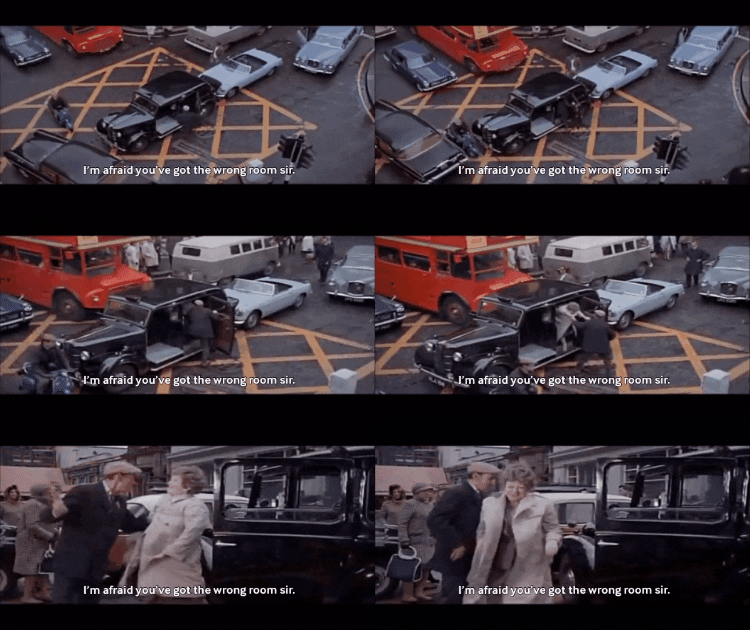
When we analysed The Killing of Sister George it became apparent that both public and private spaces offer immense difficulties for lesbians in regards to acceptance and fulfilment. The domestic disputes and theme of infidelity certainly suggests that lesbianism is not an ideal lifestyle as it causes confusion and upset in the home and havoc outside it. For example, when Childie is found to be not exclusively involved with George and is seduced by Mrs Croft. Beyond the film itself, the mere fact that Angela Lansbury refused the role that Beryl Reid accepted because she “didn’t want to play a lesbian at that time” (quoted in Bourne, 208) informs us of the pressure and discomfort that came with playing a somewhat taboo character in the space and time the film was produced. It seems actors feared homosexuality might reflect negatively on their career which demonstrates how unyielding the environment was towards the queer. It seems that for queer people there is no accepted public place for them to wholly exist in without prejudice, as no queer space can be normative and no normative space can be queer.


Friday, 1 November 2019

COMING OUT


The choice between remaining in the confines of the closet or entering the a potentially hostile space means deciding between expressing or suppressing yourself. If chosen to express oneself, an individual may no longer be required to perform a falsity, but at the price of vulnerability and exposure. Hanson illustrates this by saying “to be out is always already to be in – to be partially obscured or unspeakable and to articulate oneself within and through a rhetoric that can never be fully one’s own” (18). Coming out disrupts a previous space and lifestyle to employ a heteronormative rhetoric in which you differentiate yourself from. Arguably, there is also more vulnerability than visibility as, needless to say, queer characters are vastly under-represented on-screen and lesbians, in particular, still to this day lack a level of visibility, which films like The Killing of Sister George (Aldrich) wish to illuminate.